
Stop Contamination with PCB Cleanliness Testing
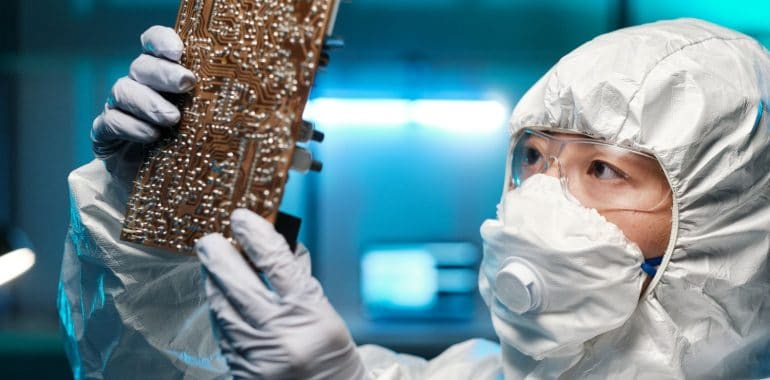
Stop Contamination with PCB Cleanliness Testing
PCB Cleanliness Testing: IPC Standards and Ionic Contamination Control
A pcb test for cleanliness verifies that a printed circuit board’s surface is free of ionic residue and particulate contamination that could compromise electrical reliability. Grounded in IPC standards developed specifically for the electronics manufacturing industry, this testing has become a fundamental quality gate for PCB manufacturers and electronics assemblers seeking to prevent corrosion-related field failures.
Why PCB Cleanliness Testing Exists as a Distinct Discipline
Printed circuit boards pack increasingly dense circuitry into smaller physical footprints, with modern boards featuring trace spacing measured in tens of microns. At this microscopic scale, preventive cleanliness testing becomes critical because microscopic contamination directly impacts long-term reliability.
Why PCB Cleanliness Testing is Essential
- Microscopic Contamination Risks: Minimal ionic contamination—such as residual flux, cleaning agent byproducts, or handling residues—can trigger electrochemical migration, trace corrosion, and reduced surface insulation resistance (SIR).
- Delayed Failure Mechanisms: Contamination-related defects typically develop gradually under operating humidity and electrical bias rather than causing immediate functional failure.
- Limitations of Functional Testing: A PCB may easily pass initial factory functional testing, yet fail after months or years in service.
- Preventive Value: Implementing dedicated cleanliness testing identifies latent reliability risks long before products reach the field, saving significant recall and replacement costs.
IPC Standards Governing PCB Cleanliness
IPC, the industry association for electronics manufacturing, has developed several standards addressing PCB cleanliness and ionic contamination that serve as the primary technical reference for this testing discipline. These standards define acceptable methodologies for extracting and measuring ionic contamination, along with guidance on interpreting results in the context of electronics reliability.
IPC cleanliness standards generally address both total ionic contamination measurement, often through resistivity of solvent extract (ROSE) testing as a rapid screening method, and more detailed ion chromatography analysis capable of identifying and quantifying specific ionic species present on a board’s surface. The relationship between these two approaches matters practically: ROSE testing provides fast, cost-effective screening suitable for routine production monitoring, while ion chromatography offers the detailed species-specific data needed for thorough investigation when contamination issues arise or when a new process requires detailed characterization.
The PCB Testing Process
A typical PCB cleanliness testing sequence using ion chromatography follows this general process:
- Sample selection, choosing representative boards from a production batch for testing.
- Extraction, rinsing the board in a controlled volume of high-purity deionized water to dissolve surface-bound ionic residue.
- Analysis, injecting the resulting extract into an ion chromatography system that separates and quantifies individual ionic species.
- Reporting, expressing results as ionic contamination concentration per unit board area, compared against IPC-referenced or customer-specific acceptance thresholds.
For boards with complex geometries—multilayer construction, buried vias, or densely populated component areas—extraction methodology needs particular attention, since contamination trapped in hard-to-reach areas may not be adequately captured through standard rinsing alone.
Where PCB Cleanliness Testing Fits in Production
Electronics manufacturers typically integrate PCB cleanliness testing at several points: after bare board fabrication to verify the manufacturing process itself doesn’t introduce excessive contamination, after component assembly and soldering to confirm that flux residue and cleaning processes meet specification, and during new product introduction to establish contamination baselines before a design moves into volume production.
Ongoing production monitoring, sampling boards periodically throughout continuous manufacturing, helps catch gradual process drift—a slowly degrading cleaning process, for instance—before it accumulates into a significant quality issue affecting substantial production volume.
No-Clean Flux and Cleanliness Testing Considerations
Many modern soldering processes use no-clean flux formulations, designed to leave minimal, low-risk residue that doesn’t require post-solder cleaning. This shift has changed how manufacturers approach cleanliness testing, since acceptance criteria for no-clean processes are typically calibrated differently than for boards undergoing full post-solder aqueous cleaning, reflecting the intentionally different residue profile these processes produce.
Manufacturers using no-clean processes still benefit from periodic cleanliness verification to confirm that flux residue levels remain within the specific thresholds established for that process, rather than assuming the no-clean designation alone guarantees acceptable reliability performance without verification.
Frequently Asked Questions
What’s the difference between ROSE testing and ion chromatography for PCB cleanliness?
ROSE testing measures total ionic contamination as a single aggregate value using resistivity measurement, offering fast and cost-effective screening, while ion chromatography identifies and quantifies specific ionic species individually, providing more detailed diagnostic information at somewhat greater cost and testing time.
How often should PCB cleanliness testing be performed in ongoing production?
Testing frequency typically depends on the board’s reliability requirements and application—high-reliability boards for automotive, medical, or industrial applications often warrant more frequent testing than boards for less demanding consumer applications, with many manufacturers establishing periodic sampling schedules calibrated to risk level.
Does board complexity affect cleanliness testing difficulty?
Yes considerably. Multilayer boards, high-density interconnects, and boards with components creating hard-to-reach areas can complicate thorough contamination extraction, sometimes requiring extended rinse times or specialized extraction techniques to ensure accurate results.
Can PCB cleanliness testing identify contamination that hasn’t yet caused a problem?
This is precisely its primary value—identifying contamination levels that, while not yet causing functional failure, indicate elevated risk of future corrosion-related reliability issues, allowing corrective action before the contamination progresses to an actual field failure.
PCB Testing Services in Malaysia
Malaysia’s extensive PCB manufacturing and electronics assembly industry requires accessible, IPC-aligned cleanliness testing to support both routine quality control and detailed contamination investigation when reliability concerns arise.
Alstesting Laboratory Testing service in Malaysia provides ion chromatography-based PCB cleanliness testing aligned with IPC methodology. Manufacturers seeking pcb test capability for ionic contamination verification benefit from testing that supports both rapid production screening and detailed species-specific analysis needed for thorough reliability assurance.